An explainer with receipts: what happened in Florida, what Islam actually says about dogs, and why this trope keeps getting weaponized
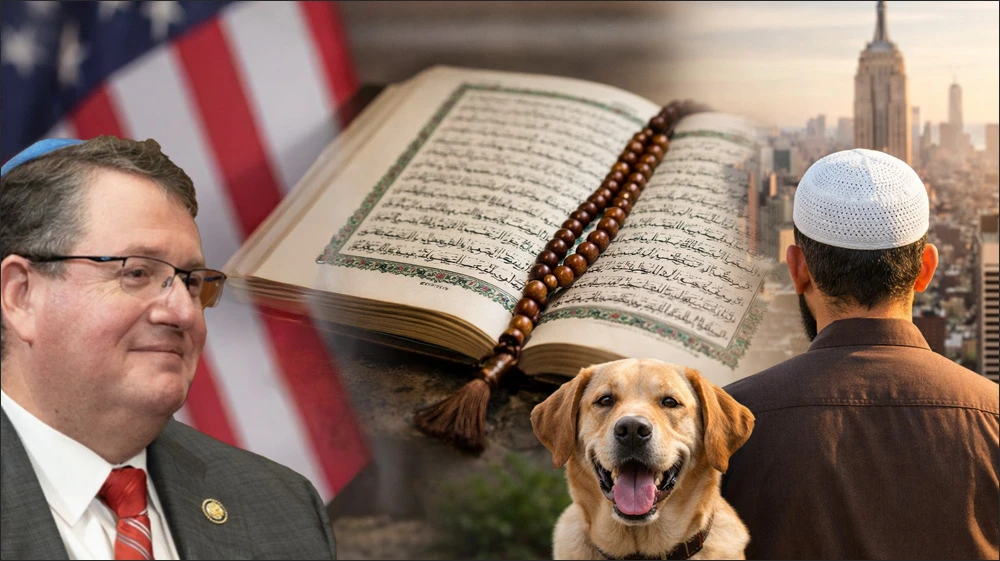
In mid-February 2026, Florida Republican U.S. Rep. Randy Fine posted on X, “If they force us to choose, the choice between dogs and Muslims is not a difficult one.”
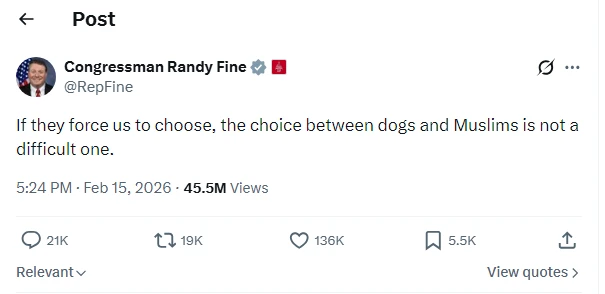
The post spread widely, drew condemnation from elected officials and civil rights advocates, and triggered calls for censure or resignation. Reuters reported the statement had drawn tens of millions of views (as of 45.5M Views) and noted critics described it as Islamophobic.
The Washington Post similarly described the backlash and reported House Minority Leader Hakeem Jeffries labeled Fine an “Islamophobic, disgusting and unrepentant bigot,” a characterization that is Jeffries’ quoted view, not a legal finding.
Fine then escalated the framing into legislation and media optics. In a press release on his official House website, he announced a bill titled the “Protecting Puppies from Sharia Act,” claiming it responded to comments he attributed to an advisor connected to New York City Mayor Zohran Mamdani, including the phrase “New York City is coming to Islam” and the assertion that dog ownership as a pet violates Islamic law.
That sequence matters because the controversy was never really about dogs. “Dogs vs. Muslims” is a rhetorical trick, built to smuggle in a dehumanizing comparison while pretending it is a cultural critique. If you want to stop that kind of nonsense from spreading, the most effective response is boring but decisive: separate the verified facts from the viral framing, then cite the primary sources that the framing depends on.
1) What Fine said, and what he said he was responding to
Fine’s “dogs vs. Muslims” line is not hearsay; it is visible in the post itself and was confirmed in mainstream reporting.
Reporting also shows he linked his post to a screenshot of a separate message that included language like “Finally, NYC is coming to Islam,” plus a claim that dogs are “unclean” and should not be indoor pets. Some coverage identifies the author of that original post as activist Nerdeen Kiswani and describes it as satire or joking, which is relevant because it undercuts the “this is a serious Muslim program” narrative Fine leaned on.
Fine’s own office then formalized the dog framing into proposed legislation and public messaging, again per his official House press release.
2) What the Qur’an says about dogs, and what it does not say
If someone claims “Islam teaches dogs are filthy,” the first check is the Qur’an, because that is the foundational text.
The Qur’an does not issue a blanket condemnation of dogs, and it includes dogs in contexts that are hard to reconcile with the idea that dogs are inherently taboo.
- The story of the Companions of the Cave includes the dog as part of the scene, “stretching its forelegs at the entrance,” without condemnation.
- The Qur’an explicitly permits eating game caught by trained hunting animals, a category classical tafsir commonly discusses using hunting dogs as an example, with conditions about training and invoking God’s name.
There is also a verse that uses a dog as a metaphor in a moral parable, but that is rhetoric about human behavior, not a legal ruling about an animal’s inherent status.
So, if we are being strict about “facts from the Qur’an,” here is the clean summary: the Qur’an mentions dogs, does not declare them inherently impure, and describes settings where dogs exist alongside people in normal, non-demonized ways.
3) What hadith say, what Islamic law does with those narrations, and why “unclean” gets oversimplified
The viral talking point is usually not “the Qur’an says dogs are unclean,” because it does not. The talking point is rooted in hadith and later jurisprudence, especially around saliva and ritual purification.
Three hadith clusters are central:
A. Washing a vessel after a dog licks it
Sahih Muslim includes reports that if a dog licks a vessel, it should be washed seven times, with earth mentioned in some narrations.
This is commonly treated in fiqh as a purity rule related to saliva, not as a doctrine that Muslims must hate dogs. And jurists disagree on what it implies.
- Shafi‘i guidance commonly treats dog-related contamination as “heavy” and uses the seven-wash framework.
- Maliki positions are often described as less stringent about dog saliva being intrinsically impure, treating the washing instruction as devotional compliance rather than proof of inherent impurity.
- Other schools and scholars draw distinctions between saliva and the rest of the body, which matters because internet arguments usually collapse everything into “dogs are filthy.”
The Evolution of the “Dog” Rulings: From Crisis to Compassion
To understand why the trope used by politicians like Randy Fine is so misleading, we have to look at the “receipts” in their proper chronological order. Islamic history shows a clear shift from a temporary emergency measure to a permanent stance of protection and utility.
Phase 1: The Initial Emergency Command
Early in the Madinan period, there was a specific period where the Prophet ﷺ did initially order that dogs be killed (Sahih Muslim 1570).
The Context: Most scholars, including Imam al-Nawawi, clarify that this was not a declaration of war on a species, but a temporary public health response to a crisis involving overpopulation and rabid/dangerous dogs in the city.
Phase 2: The Immediate Reversal
The Prophet ﷺ quickly rescinded this broad command. He famously asked, “What is the matter with them and dogs?” and restricted any killing only to the al-kalb al-aqur—the biting or rabid dog that poses a direct physical threat to the community.
He then established their fundamental right to exist, stating:
“Were dogs not a species (ummah) among the species, I would have commanded they all be killed.” (Sunan Abi Dawud 2845)
By calling them an ummah (a nation or community), he granted them a status of divine protection that exists to this day.
Phase 3: Partnership and Utility
Once the public health crisis was managed, the final, standing law of Islam was established. The Prophet ﷺ explicitly allowed Muslims to keep and work with dogs for hunting, herding, and guarding (Sahih Bukhari 2322). This moved the relationship from “conflict” to “coexistence.”
The Ultimate “Receipt”: Mercy as a Path to Paradise
Perhaps the most powerful rebuttal to the “Muslims hate dogs” trope is the famous narration found in Sahih Bukhari (3321).
The Prophet ﷺ told his companions the story of a woman who saw a dog hovering around a well, nearly dying of thirst. She took off her shoe, filled it with water, and gave the dog a drink. Because of this single act of mercy toward a dog, the Prophet ﷺ stated that God forgave her sins and granted her Paradise.
When his companions asked, “O Messenger of Allah, is there a reward for us in serving the animals?” he replied: “There is a reward for serving any living being.”
Why the Trope is Weaponized
When a politician says the choice between “Muslims and dogs” is easy, they are banking on the reader only knowing about Phase 1 and ignoring Phase 3. They take a temporary 7th-century public health measure and pretend it is the daily motivation of billions of people today. The “receipts” prove the exact opposite: in Islam, kindness to a dog is a deed so heavy it can open the gates of Heaven.
What this means for the political controversy
Fine’s defenders want the public to debate whether “Islam hates dogs,” because that debate is a distraction that reframes a dehumanizing political statement as a cultural misunderstanding.
But the actual record is straightforward:
- Islamic juristic commentary commonly frames the permissibility of killing dogs in terms of preventing harm, especially where “rabid dog” (or “vicious dog”) appears in related hadith about harmful animals. Sahih al-Bukhari includes a narration listing animals that may be killed even in the sacred precinct, including the “rabid dog.”
- A formal fatwa resource in Jordan’s official Iftaa’ Department cites Nawawi’s Sharh on Sahih Muslim in explaining “rabid dog” as a harmful, ferocious animal category and grounds permissibility in warding off harm.
- The Qur’an does not teach an inherent contempt for dogs, and it includes passages that normalize dogs in human contexts and permit trained hunting animals.
About the Author

O mankind! We created you from a single (pair) of a male and a female, and made you into nations and tribes, that ye may know each other (not that ye may despise (each other). Verily the most honoured of you in the sight of God is (he who is) the most righteous of you. And God has full knowledge and is well acquainted (with all things). ~ Quran 49:13