Challenging the Islamophobia Narrative
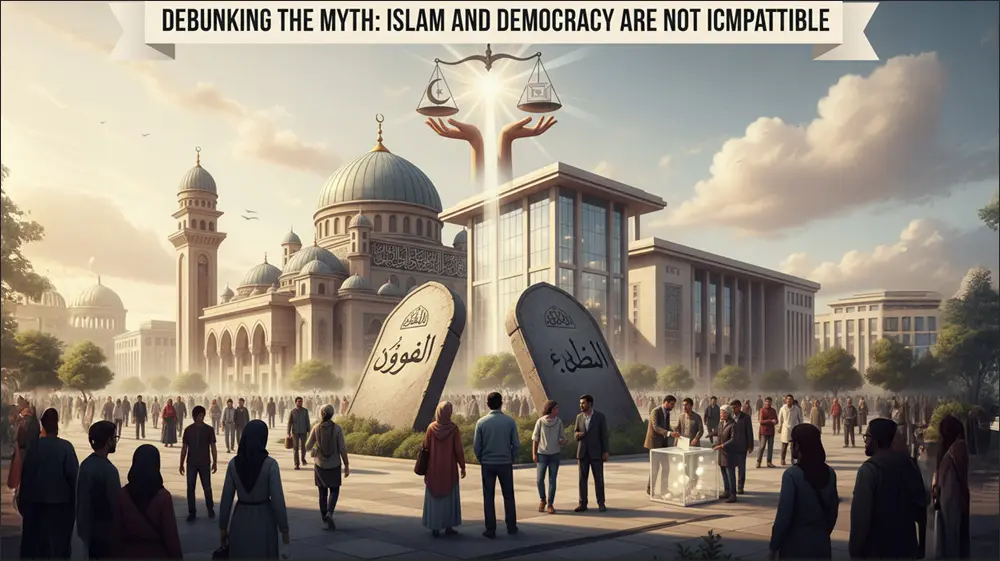
For decades, a persistent narrative has circulated claiming that Islam is inherently incompatible with democracy. This claim, often repeated by politicians, media pundits, and anti-Muslim ideologues, has become one of the most damaging stereotypes fueling Islamophobia today. But what does the evidence actually show? A thorough examination of Islamic history, contemporary politics, and democratic principles reveals a very different reality.
This article dismantles the false dichotomy between Islam and democracy, providing factual evidence that demonstrates not only their compatibility but also the rich democratic traditions that have existed within Islamic societies for centuries.
Historical Roots of Democratic Principles in Islamic Civilization
The Constitutional Tradition of Early Islamic Governance
Contrary to popular belief, the first Islamic state established by the Prophet Muhammad in Medina in 622 CE was built on a foundation of constitutional governance. The Constitution of Medina (also known as the Charter of Medina) was a groundbreaking document that established a multi-religious, pluralistic society with explicit protections for religious minorities [1].
This constitution:
- Established a framework for peaceful coexistence between Muslims, Jews, Christians, and other religious groups
- Created a judicial system with equal protections under the law
- Instituted principles of consultation and community decision-making
- Provided mechanisms for resolving disputes through established legal processes
The Concept of Shura: Islamic Consultation Democracy
One of the most fundamental Islamic principles directly supporting democratic governance is shura (consultation). The Quran explicitly mandates this principle:
“And consult them in the matter. And when you have decided, then rely upon Allah” (Quran 3:159)
Shura is not merely advisory but represents a core Islamic value requiring governance through collective deliberation and public input. This principle has been implemented throughout Islamic history through various mechanisms:
- Majlis al-Ulema: Councils of scholars providing oversight
- Diwani Systems: Administrative councils managing state affairs
- Local Councils: Community-based decision-making bodies
The Caliphate and Democratic Participation
The early caliphate period (632-661 CE) demonstrated how Islamic governance could incorporate democratic elements:
- Election of Caliphs: The first four caliphs were chosen through consensus of the Muslim community
- Accountability Mechanisms: Caliphs were subject to public criticism and could be removed for misconduct
- Public Petitions: Citizens had the right to present grievances directly to rulers
Contemporary Evidence: Muslim-Majority Democracies Around the World
The Global Landscape of Muslim Democracies
Contrary to the Islamophobia narrative, numerous Muslim-majority countries function as stable democracies with free elections, independent judiciaries, and robust civil societies:
Established Democracies:
- Indonesia: The world’s most populous Muslim-majority country, with a thriving democracy since 1998
- Turkey: Has a long history of democratic institutions despite recent challenges
- Malaysia: Maintains democratic elections and peaceful transfers of power
- Tunisia: Emerged as a democratic success story after the Arab Spring
- Morocco: Constitutional monarchy with democratic elements
Emerging Democracies:
- Algeria: Has held multiple presidential elections
- Pakistan: Despite challenges, maintains democratic processes
- Bangladesh: Regular elections and peaceful transitions
- Senegal: Stable democracy with significant Muslim population
Democratic Performance Metrics
When we examine objective measures of democratic performance, Muslim-majority countries often compare favorably to non-Muslim countries at similar levels of development:
- Indonesia ranks higher than many non-Muslim developing nations in democratic indices
- Tunisia received high marks for its democratic transition process
- Malaysia has stronger democratic institutions than several neighboring countries
Islamic Principles That Support Democratic Values
Human Dignity and Equality
The Quran establishes the principle of human dignity as a fundamental right:
“Indeed, We have honored the children of Adam” (Quran 17:70)
This principle underpins democratic values by establishing that all humans possess inherent worth regardless of race, religion, or status. Islamic teachings emphasize:
- Equal protection under the law
- Rights of minorities and religious freedom
- Prohibition of discrimination
- Social justice and fairness
Religious Freedom in Islamic Jurisprudence
Contrary to the misconception that Islam mandates religious intolerance, Islamic jurisprudence has a long tradition of protecting religious minorities:
- Dhimmi System: Historical protection for Jews and Christians living under Muslim rule
- Pact of Umar: Early agreements guaranteeing religious freedom
- Fatwas and Legal Rulings: Numerous Islamic scholars have issued rulings protecting religious minorities
Social Justice and Economic Democracy
Islamic principles strongly support economic democracy and social justice:
- Zakat: Mandatory charity system ensuring wealth redistribution
- Gharar: Prohibition of exploitative economic practices
- Mudarabah: Profit-sharing partnership models
- Islamic Banking: Ethical financial systems that prioritize social welfare
Addressing Common Misconceptions
Misconception 1: “Sharia Law is Undemocratic”
Reality: Sharia law is a comprehensive legal framework that includes democratic principles:
- Ijma (Consensus): Requires community agreement on legal matters
- Qiyas (Analogy): Allows for legal reasoning and adaptation
- Maslaha (Public Interest): Prioritizes societal welfare
- Modern Interpretations: Many Muslim-majority democracies have adapted Sharia principles to contemporary contexts
Misconception 2: “Muslims Reject Secularism”
Reality: The relationship between religion and state varies across Muslim societies:
- Turkey: Longstanding secular democracy with Muslim majority
- Indonesia: Secular state with significant Islamic political participation
- Malaysia: Constitutional monarchy with Islamic elements
- Tunisia: Post-Arab Spring democracy balancing Islamic and secular values
Misconception 3: “Islamic Movements Are Inherently Authoritarian”
Reality: Many Islamic political movements have democratic credentials:
- Ennahda Party (Tunisia): Democratic governance post-Arab Spring
- Justice and Development Party (Turkey): Elected through democratic processes
- Partai Keadilan Sejahtera (Indonesia): Participates in democratic elections
- Muslim Brotherhood (Various countries): Has contested elections when permitted
The Role of External Factors in Democratic Challenges
Colonialism and Authoritarian Legacies
Many challenges to democracy in Muslim-majority countries stem from historical factors unrelated to Islam:
- Colonial Rule: European powers often installed authoritarian regimes
- Cold War Politics: US and Soviet support for dictators
- Resource Curse: Oil wealth leading to authoritarian governance
- Foreign Intervention: Regime changes and destabilization
Geopolitical Interests
Islamophobia about democracy incompatibility often serves geopolitical interests:
- Justification for Intervention: Portraying Muslim societies as “unready” for democracy
- Support for Authoritarian Allies: Ignoring human rights abuses in strategic allies
- Islamophobia as Political Tool: Using anti-Muslim sentiment for domestic political gain
Success Stories: Muslim Democracies in Action
Indonesia: The World’s Largest Muslim Democracy
Indonesia demonstrates that Islam and democracy can not only coexist but thrive together:
- Free and Fair Elections: Regular presidential and legislative elections
- Vibrant Civil Society: Strong NGOs, media, and political participation
- Religious Freedom: Constitutional protection for all religions
- Economic Growth: Democratic governance supporting economic development
Tunisia: The Arab Spring Success Story
Tunisia stands as a beacon of democratic transition in the Muslim world:
- Constitutional Democracy: New constitution protecting democratic values
- Peaceful Transitions: Successful democratic elections
- Women’s Rights: Progressive protections for gender equality
- International Recognition: Praise for democratic transition process
Embracing the Truth About Islam and Democracy
The evidence is clear: Islam and democracy are not only compatible but have historically coexisted and continue to do so throughout the Muslim world. The narrative of incompatibility serves only to:
- Fuel Islamophobia: Justify discrimination against Muslims
- Ignore Historical Reality: Erase the rich democratic traditions of Islamic civilization
- Serve Political Agendas: Advance geopolitical interests under false pretenses
Rather than accepting harmful stereotypes, we should:
- Educate Ourselves: Learn about the actual history and contemporary reality
- Challenge Misinformation: Refute Islamophobic narratives when encountered
- Support Democratic Development: Encourage democratic growth in Muslim societies
- Promote Interfaith Dialogue: Build bridges between religious communities
The future of democracy in the Muslim world is not predetermined by religious doctrine but by the choices of people, the strength of institutions, and the support of international community. By rejecting the false dichotomy between Islam and democracy, we can work toward a more inclusive and just world for all.
Resources for Further Learning
Academic Studies
- “Islam and Democracy: Religion, Politics, and Modernity” by John L. Esposito
- “Democratic Islam: Politics and Religion in Indonesia” by Robert Hefner
- “Islam and Liberal Democracy: One or Two, Never the Twain?” by Azyumardi Azra
International Reports
- Freedom House Country Reports on Muslim-majority democracies
- World Bank Governance Indicators
- United Nations Democracy Fund reports
Islamic Perspectives
- “Islam and Democracy: Mutual Reinforcement or Incompatible Visions?” by various Islamic scholars
- Progressive Muslim organizations promoting democratic values
- Interfaith dialogue initiatives promoting understanding
This article is part of a series challenging Islamophobia and promoting accurate understanding of Islamic traditions and contemporary Muslim societies.
About the Author

O mankind! We created you from a single (pair) of a male and a female, and made you into nations and tribes, that ye may know each other (not that ye may despise (each other). Verily the most honoured of you in the sight of God is (he who is) the most righteous of you. And God has full knowledge and is well acquainted (with all things). ~ Quran 49:13