
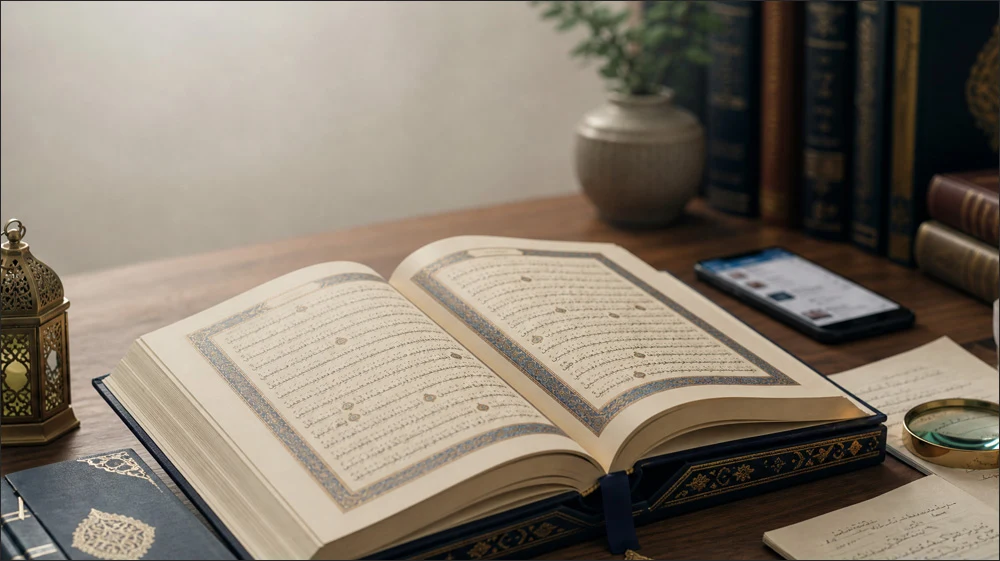
Does the Quran really tell Muslims to kill nonbelievers?
No. The Quran does contain verses about warfare, just as it contains laws, history, moral instruction, theological warnings and descriptions of the afterlife. But the viral image circulating online repeatedly removes those categories and contexts. In several places it does something even worse: it attributes words to the Quran that the verse simply does not say.
The result is not serious Quranic interpretation. It is polemics.
A passage addressing soldiers in an actual war is presented as a command to murder civilians. A verse concerning violent brigandage is rewritten as punishment for “criticizing Islam.” A description of punishment in the Hereafter becomes an instruction for Muslims to torture people on Earth. A theological statement about salvation becomes evidence of religious persecution.
And in at least one case, words such as “perverts” and “fight them” are simply inserted into a verse where they do not appear at all.
A reader deserves better than that.
The first mistake is treating the Quran like a collection of disconnected slogans
The Quran was revealed over approximately 23 years. Its passages address changing circumstances: persecution in Mecca, migration to Medina, family law, commerce, worship, diplomacy, treaties, warfare, moral behavior and relations among different religious communities.
Muhammad and the early Muslims did not begin as a military power. The Hijrah to Medina in 622 followed opposition and intolerance toward the early Muslim community in Mecca. Once in Medina, however, the community became a political society and subsequently fought real wars against Meccan and other adversaries. The Battle of Badr occurred in 624, Uhud followed in 625, Medina was besieged in 627, and a truce with the Quraysh was negotiated at Hudaybiyyah in 628. (Cambridge University Press)
That historical setting matters.
If a document says, “Fire when the enemy crosses the bridge,” removing everything except “fire” does not reveal the meaning of the document. It destroys it.
The same basic rule of reading applies to scripture.
What some of the propaganda image says and what the Quran actually says:
| Verse | Viral claim | What is being left out |
|---|---|---|
| Quran 2:191 | Kill unbelievers wherever they are found | The immediately preceding verse says to fight those who fight you and not to transgress. The following verses say to stop when the enemy stops. (Quran) |
| Quran 5:33 | Maim and crucify people who criticize Islam | The verse concerns people who wage war and spread violent corruption in the land. Classical jurisprudence associated it with hirabah—armed brigandage, robbery and severe threats to public safety—not criticism of Islam. (Quran) |
| Quran 3:28 | Muslims cannot have non-Muslim friends | The verse uses language rendered by major translations as allies or protectors, not a blanket prohibition on ordinary human friendship. Elsewhere the Quran expressly permits kindness and justice toward peaceful non-Muslims. (Quran) |
| Quran 8:12 | Behead anyone who follows a scripture other than the Quran | The verse occurs in Surah al-Anfal in the context of the Battle of Badr and addresses the battlefield, including divine assistance to the believers. It does not say “people who believe in scriptures other than the Quran.” (Quran) |
| Quran 9:5 | Kill infidels whenever the opportunity arises | The surrounding verses specifically discuss treaties and hostile parties: 9:4 orders Muslims to honor treaties, 9:6 requires granting an enemy who seeks protection safe passage, and 9:13 identifies oath-breaking and prior aggression. (Quran) |
| Quran 22:19 | Muslims should punish unbelievers with boiling water | This is a description of divine punishment in the afterlife, not an instruction to Muslims to boil anyone. (Quran.com) |
| Quran 8:65 | “Nonbelievers are stupid” and Muslims should fight them | The verse is a military exhortation to believers already engaged in conflict. The cited translation says the adversaries “do not understand,” not “are stupid.” (Quran) |
| Quran 9:123 | Muslims must attack non-Muslims living in their neighborhood | It is wartime language concerning nearby adversaries. The meme’s phrase “living in your neighborhood” is not what the verse says. (Quranic Arabic Corpus) |
| Quran 3:85 | Islam rejects other religions, therefore Muslims must persecute them | The verse is about what God accepts as religion and the person’s fate in the Hereafter. It contains no command to attack or compel anyone. (Quran) |
| Quran 8:60 | Muslims should gather weapons to terrorize unbelievers | It concerns military deterrence against an enemy. The very next verse commands Muslims to accept peace if the enemy inclines toward peace. (Quran) |
| Quran 9:30 | “Jews and Christians are perverts, fight them” | That is simply not a quotation of Quran 9:30. The verse contains theological criticism concerning claims about Ezra and the Messiah. Neither “perverts” nor a command to “fight them” appears in 9:30. (Quran) |
| Quran 47:4 | Behead unbelievers | The verse explicitly concerns encountering an enemy in battle. The same verse then discusses taking prisoners and subsequently releasing them freely or for ransom when appropriate until the war ends. (Quran) |
That distinction alone changes the picture dramatically.
Quran 2:191: the famous “kill them wherever you find them” quotation
Perhaps no Quranic phrase is circulated more often without its preceding sentence.
The meme begins with 2:191.
But Quran 2:190 establishes the subject first: fighting is directed against those who are fighting the Muslims, with an explicit prohibition against transgression.
Then comes 2:191.
Then 2:192 says that if they cease, God is forgiving and merciful. Verse 2:193 again states that when hostilities cease, aggression must cease except against oppressors. (Quran)
Removing verse 190 is therefore not a minor omission. It removes the grammatical and moral frame of verse 191.
The passage is about armed conflict, expulsion and the limits of retaliation. It is not:
“Find somebody who isn’t Muslim and kill them.”
That meaning has been manufactured by the person doing the cropping.
Quran 9:5 becomes very different when verses 9:4 and 9:6 are allowed to exist
Quran 9:5 is sometimes called the “sword verse,” and critics frequently quote its martial language.
But read the verse immediately before it.
Quran 9:4 exempts polytheist groups that kept their treaties and commands Muslims to honor those agreements until their expiration.
Now read the verse immediately after it.
Quran 9:6 says that if one of the opposing polytheists seeks protection, Muslims are to grant protection and then escort that person to a place of safety. (Quran)
Later in the same passage, the Quran identifies the enemies under discussion as people who broke their oaths, sought to expel the Prophet and “began” the aggression. (Quran)
Whatever theological debates one may have about Quran 9, reducing that entire legal and military discussion to “Islam says kill infidels whenever you can” is indefensible.
A universal extermination command does not simultaneously say:
Honor the treaty of the non-Muslim who honors his treaty.
Protect the enemy who requests protection.
Deliver him safely to his destination.
Those instructions only make sense when the subject is a specific conflict among political communities.
Quran 8:60 says prepare for an enemy — and 8:61 says accept peace
Another particularly revealing example is Quran 8:60.
The meme transforms military deterrence into “terrorism.”
The verse tells the Muslim community to possess sufficient military strength to deter or frighten an enemy. That concept should be recognizable to anyone familiar with military strategy: states maintain defensive capabilities precisely because credible deterrence can prevent attack.
But the meme conveniently stops before verse 61.
Quran 8:61 says that if the opposing side inclines toward peace, the Muslims are to incline toward peace as well. (Quran)
That adjacent sentence is inconvenient if someone wants to manufacture a theology of permanent terror.
So it disappears from the meme.
Quran 8:12 is about Badr, not murdering people of other religions
Surah al-Anfal is inseparable from the Battle of Badr. A recent academic study specifically describes the eighth surah as connected to the 624 battle and its aftermath. (DOI)
Quran 8:12 describes God strengthening the believers during that battle and speaks in stark battlefield language.
One may find ancient warfare uncomfortable. That is understandable.
But discomfort does not justify changing what a passage is about.
The meme transforms a battle against a military opponent into a command to “behead those who believe in scriptures other than the Quran.”
Those words are not what Quran 8:12 says. (Quran)
Christians, Jews, peaceful neighbors, contemporary civilians and anyone merely possessing another scripture have been inserted into the quotation by the meme’s author.
Quran 5:33 does not order Muslims to mutilate people who criticize Islam
This may be the most blatant distortion in the image.
Quran 5:33 deals with those who wage war and spread severe corruption or disorder.
In classical Islamic jurisprudence, the verse became foundational to discussions of hirabah. Scholars differed over its precise legal boundaries, but the concept was associated with crimes such as armed brigandage, highway robbery, terrorizing communities and grave attacks upon public security. Cambridge and Brill scholarship document those legal discussions. (Cambridge University Press)
“Someone criticized Islam” is not what the verse says.
In fact, the Quran repeatedly portrays people rejecting, disputing and criticizing the Prophet’s message. The response prescribed for religious disagreement includes reasoned invitation and debate: Quran 16:125 tells believers to invite others with wisdom and good instruction, while Quran 29:46 tells Muslims to engage the People of Scripture in the best manner. (Quran)
That is very different from executing critics.
Quran 22:19 exposes another common trick: turning God’s judgment into human violence
The image says Quran 22:19 orders Muslims to punish unbelievers with garments of boiling water and melt their skin.
Read the verse.
It is describing Hell.
It is an eschatological passage about divine judgment in the Hereafter. No Muslim is commanded to perform the punishment. (Quran.com)
This distinction is fundamental.
Christian scripture describes Hell. Jewish and Islamic scriptures describe divine punishment. That does not mean believers have been authorized to physically carry out God’s descriptions of the afterlife.
Conflating “God says this will happen in the Hereafter” with “God orders you to do this to your neighbor” is not interpretation.
It is a category error.
Quran 3:85 makes a theological claim, not a coercive political command
Quran 3:85 teaches that a religion other than submission to God will not be accepted in the Hereafter. (Quran)
A Muslim believes Islam is true.
A Christian believes Christianity is true.
A Jew believes Judaism is true.
An atheist may believe all three are mistaken.
Holding a truth claim is not the same thing as forcing somebody else to adopt it.
The Quran can simultaneously say Islam is true and you may not force somebody to believe Islam.
There is no contradiction between those propositions.
The Quran could hardly be clearer that faith cannot be forced
Quran 2:256 contains one of the most direct religious-liberty statements in scripture:
“There shall be no compulsion in religion.” (Quran)
Quran 10:99 asks the Prophet whether he would compel people until they became believers, after stating that God Himself could have made everyone believe had He willed. (Quran.com)
Quran 18:29 presents truth and then leaves the human being with the choice to believe or disbelieve—while also making clear that choices have consequences before God. (Quran)
And Quran 109 concludes with the recognition:
“For you is your religion, and for me is my religion.” (Quranic Arabic Corpus)
This is an important distinction sometimes lost in modern discussions of religious freedom.
The Quran does not say every theological belief is equally correct.
It says human beings have the capacity to accept or reject God’s guidance and will ultimately answer to God for that decision.
Accountability to God and coercion by human beings are not the same thing.
The Quran explicitly commands Muslims to treat peaceful non-Muslims justly
Another verse almost never appearing in anti-Muslim memes is Quran 60:8.
It states that Muslims are not prohibited from treating with goodness and justice those who do not fight them because of religion or expel them from their homes. Indeed, God loves those who act justly. (Quran)
Quran 5:8 goes even further: Muslims must not allow hatred of another people to cause them to behave unjustly. (Quran.com)
That principle matters enormously.
Islam does not merely require justice toward people Muslims like.
Justice is required even when animosity exists.
Quran 49:13 describes humanity as peoples and tribes created so that they may know one another, with moral worth before God based not upon ethnicity or tribe but righteousness. (Quran)
Quran 29:46 instructs Muslims to engage Jews and Christians respectfully and reminds them of their shared belief in one God. (Quran)
And Quran 5:5 goes so far as to permit Muslim men to marry chaste Jewish or Christian women and recognizes food shared between the communities. (Quran)
A civilization supposedly commanded to treat every non-Muslim as an enemy would have difficulty explaining why its scripture simultaneously anticipates them becoming one’s spouse, relatives, dinner guests, neighbors and partners in society.
What about Quran 9:29 and warfare with Jews and Christians?
A serious response should not hide difficult passages.
Someone checking the meme’s false quotation of Quran 9:30 may notice that the preceding verse, 9:29, does contain a military command involving certain People of the Book and jizya.
That deserves an answer.
Academic scholarship has connected the immediate setting of 9:29 with the late Medinan period and the Tabuk expedition toward the Byzantine frontier. One Oxford legal study argues that the passage should be read against the political and military relationships of seventh-century Arabia rather than as a free-standing perpetual order to attack Jews or Christians because of their private beliefs. (OUP Academic)
At the same time, honesty requires acknowledging another historical fact: later classical Muslim jurists did not all understand warfare in the narrow modern sense of immediate self-defense. Many developed doctrines permitting state-led expansionary warfare within the international assumptions of their time. Modern Muslim scholars have debated how those medieval doctrines relate to contemporary nation-states, treaties and international law. (OUP Academic)
There is no reason to erase that history.
But there is also a tremendous difference between saying:
“Premodern Muslim states developed doctrines governing war with other states”
and saying:
“Islam commands Muslims today to murder their Jewish or Christian neighbors.”
The first is a question of history and jurisprudence.
The second is propaganda.
Islam is not pacifism — and it does not have to be
Part of the problem may come from the familiar expression “Islam is a religion of peace.”
If that phrase is interpreted as “Islam forbids every use of force under every imaginable circumstance,” then it is inaccurate.
Islam is not absolute pacifism.
The Quran recognizes war as a tragic reality and permits fighting under circumstances addressed throughout its Medinan passages. It discusses deterrence, military preparedness, prisoners, treaties, retaliation and peace agreements.
But permitting warfare is not equivalent to glorifying indiscriminate violence.
Quran 2:190 restricts aggression. Quran 8:61 commands acceptance of peace. Quran 47:4 discusses releasing or ransoming prisoners when battle ends. Quran 60:8 commands justice and goodness toward those who do not fight Muslims. (Quranic Arabic Corpus)
A more meaningful statement would therefore be:
Islam teaches that peace, justice and human dignity are moral objectives, while recognizing that force may sometimes be necessary against aggression and oppression. Even then, force is subject to ethical limits.
That is considerably more sophisticated than either “Islam has no war verses” or “Islam teaches Muslims to kill everybody else.”
Neither extreme survives serious examination.
And yes, Muslims sometimes violate Islam
Another important point should not be avoided.
There are Muslims who commit terrible acts.
There are Muslims who murder innocent people.
There are Muslims who mistreat women, persecute minorities, cheat customers, lie, steal, exploit workers, abuse power or behave cruelly while still calling themselves Muslims.
A Muslim label does not magically transform every action committed by a Muslim into an Islamic action.
People violate the values they profess every day.
The existence of a dishonest Muslim does not mean Islam teaches dishonesty.
The existence of a violent Muslim does not prove Islam commands unjust violence.
And pointing this out is not an attempt to avoid responsibility. Muslims should condemn wrongdoing committed by Muslims precisely because moral accountability is part of Islam.
The proper question is not:
“Has a Muslim ever committed violence?”
Obviously Muslims have.
The proper question is:
“Does the Quranic text being cited actually teach what this person claims it teaches?”
In the case of this viral image, repeatedly, the answer is no.
Some extremists and some anti-Muslim activists make the same interpretive mistake
There is an uncomfortable irony here.
Violent extremists sometimes isolate the same wartime passages that anti-Muslim polemicists circulate online.
Both benefit from erasing qualifying verses.
Both benefit from removing historical context.
Both benefit from pretending that a seventh-century military confrontation is a universal instruction governing every Muslim’s relationship with every non-Muslim forever.
Scholarship examining groups such as ISIS has documented deliberate distortions of Quranic interpretation to legitimate contemporary violence. (Brill)
Muslims should reject that method regardless of who uses it.
A verse does not acquire a different meaning merely because one extremist quotes it approvingly and another critic quotes it accusingly.
Context still matters.
Five questions to ask whenever someone posts a frightening Quran verse
- What do the verses immediately before and after it say? Many viral quotations disappear once the surrounding passage is restored.
- Who is being addressed? A prophet, an army, a government, criminals, believers generally, or humanity as a whole?
- What kind of passage is it? A command, historical narrative, legal ruling, theological statement, metaphor or description of the afterlife?
- Is it discussing peace or an active war? A command governing enemy soldiers cannot simply be transferred to civilian neighbors.
- Is the meme actually quoting a recognized translation? Words such as “perverts,” “stupid,” “criticize Islam” and “living in your neighborhood” should immediately prompt readers to check the text for themselves.
That simple process would eliminate much of the misinformation circulated about the Quran.
Religious disagreement does not erase human dignity
Muslims do not have to pretend that every religion teaches the same thing.
They plainly do not.
Islam has theological disagreements with Christianity.
Christianity has theological disagreements with Islam.
Judaism disagrees with both on important matters.
Atheism rejects foundational claims made by all three.
Real tolerance does not require pretending those differences do not exist.
It requires recognizing the human being on the other side of the disagreement.
The Quran’s instruction is not to abandon conviction but to combine conviction with justice.
Do not compel belief. (Quran)
Do not allow hatred to produce injustice. (Quran.com)
Treat peacefully disposed people with goodness and fairness. (Quran)
Discuss religious differences in the best manner. (Quran)
And understand that ultimately God—not a Facebook meme, an extremist organization or an angry individual—judges what is inside another person’s heart.
The Quran should be challenged honestly, not rewritten
No one is required to believe the Quran.
The Quran itself recognizes that some people will believe and others will not. (Quran)
People are free to question Islam.
They are free to disagree with Islam.
They are free to criticize Quranic ethics, Islamic history or Muslim interpretations.
Muslims should be prepared to discuss those criticisms seriously.
But criticism should begin with intellectual honesty.
If a verse concerns war, say it concerns war.
If it concerns Hell, say it concerns Hell.
If it concerns criminal violence, do not rewrite it as punishment for criticism.
If the verse says “allies,” do not casually transform that into “you may never have a non-Muslim friend.”
And if words such as “perverts” or “living in your neighborhood” are absent from the Quran, do not put quotation marks around them and tell millions of readers that God said them.
That is not scrutiny.
That is misinformation.
Muslims should not fear context
Muslims also should not respond to criticism by pretending difficult history does not exist.
There were wars.
There were empires.
Muslim rulers committed injustices.
Muslim scholars disagreed with one another.
Interpretations developed under political and historical circumstances radically different from our own.
Acknowledging those realities does not weaken Islam.
It makes the discussion more intellectually responsible.
Our faith does not depend upon proving that every Muslim ruler was righteous or that every person who ever invoked Islam understood it correctly.
People remain people.
They can act nobly.
They can act terribly.
And they can invoke religion while doing either.
The standard must therefore remain the principles themselves: justice, truthfulness, restraint, mercy, accountability and submission to God.
The bottom line
The viral image succeeds only if the reader never opens the Quran.
Once the surrounding verses are restored, several of its claims collapse immediately.
Quran 2:191 follows an instruction to fight those who fight you and not transgress.
Quran 9:5 stands between commands concerning treaties and safe passage.
Quran 8:60 is immediately followed by an order to accept peace.
Quran 47:4 is explicitly about battle and then addresses the release or ransom of prisoners.
Quran 22:19 describes the afterlife rather than instructing Muslims to torture anyone.
Quran 5:33 concerns violent public wrongdoing, not criticism of Islam.
And Quran 9:30 simply does not say what the meme places inside quotation marks.
At the same time, the Quran declares that religion cannot be forced, asks the Prophet whether he would compel people to believe, commands justice even toward people one dislikes, permits good relations with peaceful non-Muslims and tells Muslims to discuss religion with others respectfully. (Quran)
Islam does not require us to deny the existence of war.
It requires us to reject injustice—even when discussing our enemies.
And that principle should apply to discussions about Islam as well.
Frequently Asked Questions
Does the Quran say Muslims should kill nonbelievers wherever they find them?
No. Quran 2:191 contains battlefield language, but the passage begins in 2:190 by restricting fighting to those who fight Muslims and prohibiting transgression. It subsequently instructs Muslims to cease aggression when the opposing side ceases. (Quran)
Does Islam permit forced conversion?
The Quran explicitly states that there is no compulsion in religion. Quran 10:99 also rejects the idea that the Prophet should force people into belief. Islamic theology teaches that people are accountable to God for belief and unbelief, but divine accountability is different from forced conversion by other human beings. (Quran)
What is the historical context of Quran 9:5?
The surrounding passage concerns treaties and armed conflict with particular polytheist groups. Quran 9:4 requires existing treaties to be honored, Quran 9:6 grants protection and safe passage to an opposing polytheist requesting asylum, and Quran 9:13 describes treaty-breaking and prior aggression. (Quran)
Does Quran 9:30 call Jews and Christians “perverts”?
No. The word “perverts” does not appear in the verse, nor does Quran 9:30 contain the meme’s command “fight them.” The verse is a theological polemic concerning claims about Ezra and Jesus. (Quran)
Can Muslims be friends with non-Muslims?
The Quran does not impose a blanket prohibition on ordinary friendship or kindness toward non-Muslims. Quran 60:8 expressly permits and praises righteousness and justice toward those who are peaceful, Quran 5:5 permits marriage with women from the People of the Book, and Quran 29:46 instructs Muslims to engage Jews and Christians respectfully. (Quran)
If Muslims commit terrorism or atrocities, does that prove Islam teaches those acts?
No. The conduct of someone who identifies as Muslim must still be evaluated against Islamic teachings. Muslims, like all human beings, can violate the moral principles they profess. That does not excuse wrongdoing; it is precisely why Muslims should condemn actions that contradict Islamic requirements of justice and protection of innocent life.
About the Author

O mankind! We created you from a single (pair) of a male and a female, and made you into nations and tribes, that ye may know each other (not that ye may despise (each other). Verily the most honoured of you in the sight of God is (he who is) the most righteous of you. And God has full knowledge and is well acquainted (with all things). ~ Quran 49:13